Three Ways to Recognize Cultural Trauma

Cultural trauma has harmed people deeply, overpowering how we operate, whether by society’s standards or family expectations, often an overlap of both. Here are some ways to understand whether it’s something that impacts you. If so, examine it so you can begin to heal.

  1. Separate cultural norms from trauma. Understand what you uniquely need according to who you are in dynamic ways, from a cultural perspective. What are the unique traits that define you in the community you’ve been a part of? What intrinsic interests do you have that are tied to your culture? These are the healthy aspects of cultural influence. Also identify the ways culture may feel restrictive and may even be harmful to your well being, sense of safety, and individuality.
  2. Pull apart what you know to be your beliefs versus society’s or family’s belief systems. Beliefs are deeply rooted and can be harder to pull apart versus understanding more tangible needs, such as what was mentioned in point one. We can be influenced by others’ perspective, especially family, but when families are enmeshed, meaning lack of clarity in how each person is different than the other in their own beliefs and views. Lines are blurred regarding what each person likes, wants and hopes for the future. This creates issues in setting boundaries and having others respect them.
  3. Notice how difficult or easy it is to disagree with cultural norms, especially related to how they do or don’t apply to your life. Is it taboo to do something outside of cultural norms? Would you be judged? Would you be shunned? Sometimes people living outside of cultural restrictions are even disowned.

Learn where the boundaries are between cultural demands and what you authentically seek out of life. It’s healthy to recognize these differences. It leads to the ability to say no. It leads to finding a sense of self after living under restrictive cultural mandates that may have been a barrier to peace, joy and the freedom to connect with ourselves. It leads to embracing the parts of culture that define us and separate from the ones that are enforced upon us.

Release the Shame. It’s Not for You.

Some days we may ask ourselves whether anyone else would be able to relate to the pain we’re experiencing or the crazy of what happens behind closed doors.

Some may not. But there are many who do because this is life. If we’re breathing, we have or will experience challenges. We fear something is wrong with us because of our story or because we feel we’re unique in our pain, but others have similar stories they feel they must keep locked in. They worry about blaming others, shaming others, others who they love but were hurt by. It’s not about that though, is it? It’s about releasing pain. This is why sharing stories is like sewing together a thick, comforting blanket of healing.

This is why I tell my story. And what is yours? The one you may hold undue guilt or shame about? The one you believe no one would understand? Release it in writing, in song, in dance. Allow someone you trust to help walk with you on the journey. Release the shame. It’s not for you.

How Do We See “Those People Over There?”

IMG_3296How do we care for ourselves even when we feel like dominoes are collapsing all around us? How do we ground ourselves in unfamiliar interactions so that we are having meaningful conversations rather than inciting pain?
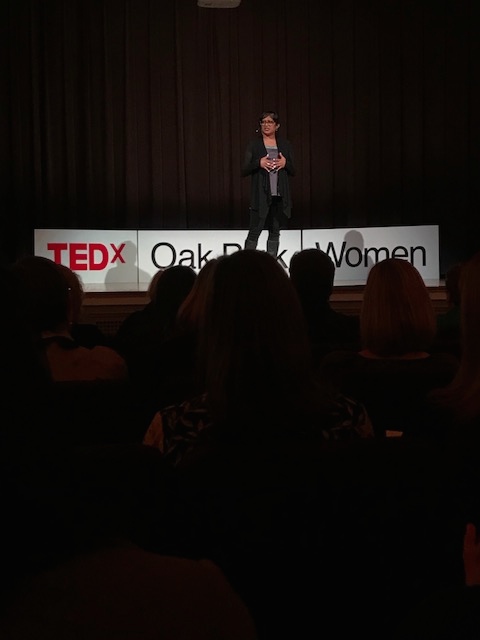


I reflected on these ideas in a recent TEDx talk on widening our view of humanity, especially with those who may be unlike us. In cultivating my ideas, I took a closer look at the nature of humanity and the divisions we so easily make, sometimes void of reflection, love or kindness. How powerful it would be if we instead attempted to unite with those who are very different from us at first glance?

It was frustrating however, that even as I was preparing to speak on how to have conversations that push us forward, I felt my own painful experiences coming to the surface. I was challenged by the mandate to walk in love and listen intently, while also wanting to fight with angry words, hoping to force people to reverse the hate in their hearts.

And at other times, I was staring at the ugly biases insidiously rising within me. No one is immune to these complexities, no matter how aware we think we are or how deeply we contemplate these things.

I was challenged to see what lies beneath division, to find that we have simplistic, dichotomous ways in which we choose who we love and who we choose to despise.
We quickly paint pictures of unfamiliar people as others, and as the dreaded and misunderstood them over there. And the others are sometimes depicted as less than, undeserving of respect, and in the most heinous circles, even unworthy of living.

This process doesn’t surface overnight. The need to hastily throw people into categories is insidious. It is nurtured in fear, isolation and ignorance over the course of time. And yet again, no one is immune. The sweetest little church lady may harbor hate toward someone who is unlike her. She’d probably call it something different, maybe labeling it as protecting herself, even though there’s nothing to be afraid of.

Fear is powerful and vile, if fed over time. It can become one’s demise if overtaken by it, both mentally and physically.

Harboring fear that transforms into anger, resentment and hate can annihilate us. We mustn’t weaponize fear the way some do.
Then, in order to care for society in all of its complexity and beauty, we must listen intently to what others are saying. And in doing this, we also care well for ourselves, because after all, we are all others and so we are all one.

IMG_8137.jpg

Hear the talk: Confidently Changing the Narrative of Inequity.

We are Conquistadors!


IMG_4513

I did it! Actually, we did it. There could be no other way. You, my dear, were the reason they were finally willing to understand the world as it should be seen.

When my parents came to America, they brought with them a few belongings, some big dreams and a host of misconceptions about what the people of America were like. In fact, they seemed to understand all non-Indians in a grossly inaccurate, almost caricaturistic light. It wasn’t malicious, it was simply their perspective.

In fact ironically, when I think of their perceptions, they parallel to Americans’ views of Apu from The Simpsons. He’s a clownish little Indian man with a heavy accent and unethical business practices. In the same vein, my parents saw all Americans as sex crazed hippies with no concept of collectivism, family, sacrifice or desire to maintain an untainted reputation, regardless of the costs.

It makes some sense. They would be encountering so many people unlike themselves, they had to create a sort of blueprint for understanding the many puzzle pieces that made up America. This can be useful to a degree I suppose, but it was also quite harmful. It drew lines between the perceived stark differences separating Indians and “the others.”

My parents were unable to relinquish how their custom-laden world could even vaguely line up with any strand of American culture. And further, meshing even slightly with “bad, loose, selfish” America would be treason of Indian culture.

Had my parents considered though that their children were born into this sin and may one day adopt some of these dreaded qualities? Well, no. Not for a long, long time, not until they had to face you, my very un-Indian boyfriend. Until then, they held on tight to their misinformed notions, which sometimes unwittingly teetered on the brink of intolerance.

And so when you came along, the concept of us was incomprehensible to them, a paradox. But slowly they began to bend. The change was so subtle that it almost went undetected. It was in the small interactions – silence replaced by laughter, formalities replaced by meaningful exchanges – that they were being redefined. They needed you, they needed light. They needed exposure and reflection of their own vulnerabilities.

We did this! We pushed them out of their uncomfortable places. We showed them something they had never dreamt of. We, my love, are conquistadors!

The Ominous They

IMG_4522

Tyrion, a fearless man who perpetually battles many odds, offers telling words to live by as he refers to a frightful yet elusive force – they.

Tyrion: “Podrick.”

Podrick: “Yes, my Lord.”

Tyrion: “They’ll be following you now.”  

Podrick: “Who will?”

Tyrion: “I don’t know. They, they, the ominous they.” 

Game of Thrones

•••••

Tyrion alludes to the reality that they are an ill-defined bunch. Yet our achievements and fears are so often driven by relentless worry about what they might think or say.  But ultimately, outside of the people who are most precious to us, the others have little impact on our life decisions. They may have opinions but they have no real impact.

How many times have we allowed some warped image of they to grow into an all-powerful force in our imagination and stunt us from birthing a new idea or relationship? We ask ourselves, What will people think? Well, they’re going to think whatever they want to think. They’ll probably think a lot of things, in fact.

But the more important question is, Will that change how you live? What will you do: Will you do what they want or what you’ve been dreaming of? They, while ominous and oppressive will continue to wallow and flail in their misery and customs. But you and I… we will move forward and be curious, creative and beautiful in spite of it.