How Do We See “Those People Over There?”
IMG_3296How do we care for ourselves even when we feel like dominoes are collapsing all around us? How do we ground ourselves in unfamiliar interactions so that we are having meaningful conversations rather than inciting pain?

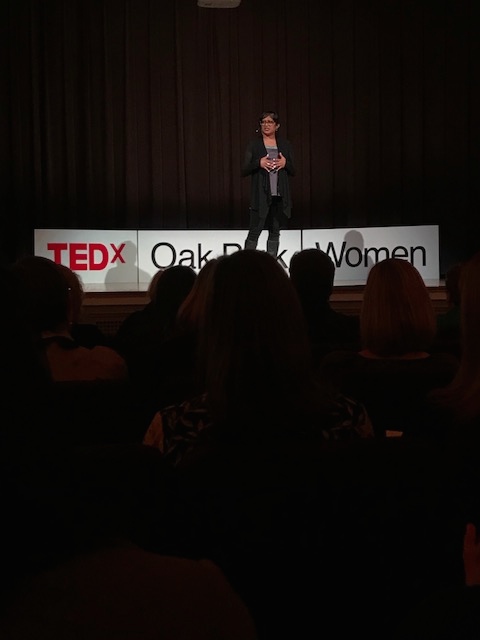
I reflected on these ideas in a recent TEDx talk on widening our view of humanity, especially with those who may be unlike us. In cultivating my ideas, I took a closer look at the nature of humanity and the divisions we so easily make, sometimes void of reflection, love or kindness. How powerful it would be if we instead attempted to unite with those who are very different from us at first glance?

It was frustrating however, that even as I was preparing to speak on how to have conversations that push us forward, I felt my own painful experiences coming to the surface. I was challenged by the mandate to walk in love and listen intently, while also wanting to fight with angry words, hoping to force people to reverse the hate in their hearts.

And at other times, I was staring at the ugly biases insidiously rising within me. No one is immune to these complexities, no matter how aware we think we are or how deeply we contemplate these things.

I was challenged to see what lies beneath division, to find that we have simplistic, dichotomous ways in which we choose who we love and who we choose to despise.
We quickly paint pictures of unfamiliar people as others, and as the dreaded and misunderstood them over there. And the others are sometimes depicted as less than, undeserving of respect, and in the most heinous circles, even unworthy of living.

This process doesn’t surface overnight. The need to hastily throw people into categories is insidious. It is nurtured in fear, isolation and ignorance over the course of time. And yet again, no one is immune. The sweetest little church lady may harbor hate toward someone who is unlike her. She’d probably call it something different, maybe labeling it as protecting herself, even though there’s nothing to be afraid of.

Fear is powerful and vile, if fed over time. It can become one’s demise if overtaken by it, both mentally and physically.

Harboring fear that transforms into anger, resentment and hate can annihilate us. We mustn’t weaponize fear the way some do.
Then, in order to care for society in all of its complexity and beauty, we must listen intently to what others are saying. And in doing this, we also care well for ourselves, because after all, we are all others and so we are all one.
IMG_8137.jpg

Hear the talk: Confidently Changing the Narrative of Inequity.

What Sharing Privilege Looks Like

e42aeff9ec4e61068ad6670bd75f5ab9

A teenage girl came in for psychological services. Like most young people, she was guarded at first but eventually began talking about a difficult past riddled with cruelty followed by abandonment. She cried at times, ensuring to avert eye contact. Teenagers are so hard to reach, I was glad she felt she could share. We laughed together a little near the end of the session, often a relieving sign of a glimmer of hope. But even still, there was something unsettling about her.

She missed her follow-up appointment. I hoped she would return soon. The heaviness she carried shouldn’t have to be contained in such a young life. As weeks passed, I continued to wonder how she was doing and whether anyone was helping her hold her pain, and whether someone, just even one person, told her she was loved.

Then one day, just like that, she was back. As I was scanning the waiting area to check on another client’s arrival, I saw the girl sitting with shoulders hunched and staring into her hands. After wrapping up some paperwork, I headed over to the waiting area to call her in.

But before I could open the door, my colleague, Julia stopped me. “I’m sorry, the client said she didn’t want to see the ‘dark one.'” I’m so sorry that some people are that ignorant.” I wasn’t naive. I was working in the hometown of a former grand dragon of the KKK, but it did feel a little like I was kicked in the stomach.

As I was walking through the waiting area a while later, I saw the young lady standing at the receptionist desk with an older man. He glanced my way and immediately began throwing daggers at me with his eyes, as though he was an automated cyborg ordered to do so. As the girl noticed this silent interaction, she began to mimic him.

But her gaze was unlike his piercing and defiant stare. Hers was filled with deep emptiness. I walked away wondering if she even knew why she thought she loathed me. The lines between sadness and anger, fear and hate are so very thin.

I almost felt defeated. She was too young to despise anyone, but I suppose she was also too impressionable not to. She was vulnerable in many ways, one of those being that she didn’t yet have her own sense of self-worth, so how could she accept anyone else? I say I almost felt defeated because seeing Julia knew exactly what to say, exactly what I needed to hear, was the buffer. It was the hope that one day more people will be reasonable, less intolerant. She validated my disappointment that it’s a tragedy to feel this girl is unreachable right now,  she acknowledged that this was a case of hate having had won.

That one statement was a million consoling words for me. Julia could have said, “Oh, that’s just how it is around here,” or “She’s young,” or “She didn’t mean it that way.” But instead, she called it out for the vile thing it was. Hate begets hate.

And what hurt most was that the girl was somewhere around 15 years old. She wasn’t 70 and stuck in a different era, still calling people of color negroes or coloreds like some of my patients had. This was taught to her, passed down from those 70 year olds, and onto those 40 year olds, and now onto her impressionable young mind, once pure, as God created it. Through generations, she was given the gift of hate.

Although it was disappointing, it was a little easier to face knowing Julia was aligned with me. She was aligned despite it not happening to her, despite having no direct impact from it, despite her being white and being completely unaffected, if she chose to see it that way. But she chose otherwise. She didn’t have to sacrifice anything to align with me. She didn’t have to move aside and relinquish her privilege. She was simply human in all its beauty –  willing to hold my disappointment with me.

And this is what sharing privilege looks like.

Ridiculous Lessons I Learned From My Indian Parents

IMG_3848

  • Mad respect to chai. Learn to make it and everything else in life falls into place.
  • Spankings are bonding time.
  • They’re not actually mad when they yell. That’s just how they talk.
  • You’re not Indian, you’re American, that’s until you want to do American things like hang out with friends til 1am. Then they’re like, “Indians don’t go outside after 9pm.” Hmmm. I didn’t know there was a special Indian curfew.
  • It’s not turn off the light, it’s off the light. It’s not turn off the TV, it’s close the TV. Keep up.
  • Grades define who you are, but don’t worry, that’s only until you’re an adult. And then it’s your career. By the way, sports and art are dumb.
  • Always wear super shiny clothes no matter where you’re going.
  • When you’re walking around the grocery store with your really shiny Indian clothes on and people stare, you’re supposed to yell, “Hey! Vat the hell are you looking at?!”
  • Stare back at people really hard whenever the opportunity arises because all Indians have this amazing genetic affinity for it. And don’t worry, you’re guaranteed to win a dirty look stare down contest any day. Boom.
  • Don’t make fun of your parents’ accents for more than 2 minutes straight because even though they laugh along for a while, they’ll eventually get super offended.

“Vy are you making the fun? Ve talk beautiful English.”


Firecracker Chokehold: A Mother’s Lament

IMG_3526.JPG


In the past two months

Our streets took five

How did I manage

Not to die

Most of all can’t get images

Of how he bled

Outta my dreams

Outta my head

Feeling high

Anxiety

Why am I alive

Just let me be

Why was it

That I was spared

Who’s watching me

Who even cares

How come I

Have to live here

In legalized

Guerilla warfare

Why do innocents

Get shot down

Even if

They’re standing down

I can’t sleep

My appetite’s gone

I can’t remember

One consoling song

I can’t focus

It’s all a joke

I can’t breathe

I’m being choked

Panic swarms me

Lies abound

Firecrackers

Are terrible sounds

I can’t leave

My house no more

I don’t care

What’s behind this door

Lord protect me

Where can I go

I think I just wanna

Come on home

That’s crazy talk

I don’t know anymore

Hope is dwindling

I can’t keep score

On who shot who

And affiliation and all

I just know

My baby’s gone

Nothing’s good

And nothing’s right

Give me strength

For another long night

Why She Stays: Behind the Doors of Domestic Abuse

IMG_4854.jpg

Why do you think she stays? Because she wants to? Because she loves him that much? Maybe. But she may also stay because red is the only color she can identify when she sees him. She may stay because she’s terrified of the thought of her children having to live in a shelter, having no financial resources, having no one to rely on. She may stay because he threatens to take her children if she tries to leave.

In the eyes of others, he’s charming and kind. But no one knows that he’s also someone who pays the children’s school fees if he feels like it, and the light bill or buy groceries some of the time, but there’s usually a catch. He always makes sure she and the kids feel guilty about it, as though they’re strangers depending on his unjustified kindness. He’s someone and he’s no one, all at once. This is where her confusion lies.

There are also other things he is not. He is not someone who can give love, because he cannot receive it. He is not someone who is able to put himself in anyone else’s shoes. He is not someone who will share her burdens. He is not someone who wants to model compassion and integrity for his children. He doesn’t know how to pretend to be these things, nor does he care to.

He is not someone who will protect his family, and in fact, he is the one from who they need protection. He is secretly proud of his cowardly ways.

So you ask, why does she stay? What’s wrong with her? Well, would you leave if you had nowhere to go, no one who could help you, no money to feed your children or no way to get them to school or doctors’ appointments? What about if he took away your family’s medical insurance? And what about if your child had some chronic condition? What if he threatened to call immigration?

It seems easy to question some other random person. Yet, it’s more often not some other random person, it’s your co-worker, your neighbor, your friend, your sister. Maybe it’s you. Maybe you don’t know it is. Maybe you think someone else’s situation is worse and so you justify to yourself that yours isn’t that bad, so it couldn’t be considered abuse.

He doesn’t punch or slap you like those other men. He only occasionally curses at you or randomly accuses you of cheating when he’s really angry. Sometimes he shoves you but always says he feels terrible afterward. He doesn’t stop you from working. Yet he drops by unannounced from time-to-time, and come to think of it, more frequently lately.

He says he loves you so much he wants to spend all of his time with you, especially when you try to hang out with friends or make plans to see family. He says he wants to take care of the finances. He gives you an allowance because it’s convenient. He feels there is no need for you to have access to the account. Access for what?

No, no, no. None of this is me, you say. Okay. But are you afraid to say the wrong things, to do something that might upset him, go to places he may not approve of, wear clothes he might find inappropriate? Do you have a running reel in the back of your mind of what he might say about this or that, about just about every decision in your life?

But you’re always on his mind because he cares, you say. I get it. It’s all very difficult. It’s insidious. It’s perplexing. Comprehending his intentions can be difficult and even the fleeting idea of leaving is not an easy one to consider.

Let’s now once again reconsider why she stays, why you stay, why we stay, why we’ve considered leaving, why we don’t have to do any of it alone whether we stay or go. Most of us, 1 out of 3 females in fact, has been abused, most often by a loved one. You are not alone.

So again I want you to believe me when I say it, you don’t have to do it alone, no matter what you decide.

Originally published at http://www.girlsglobe.org on June 5, 2017.